Barbara Lee is “undoubtedly the principled pick for any socialist or progressive in [the California Senate] race,” as the California chapter of the Democratic Socialists of America (“California DSA”) explains in their recently released voter guide.
Because Lee is in fourth place in recent polls, however, California DSA also states that progressive voters “might want to consider tactically voting” for Katie Porter, the second-most progressive candidate, to avoid a general election battle between corporate Democrat Adam Schiff and Republican Steve Garvey. (In California’s “jungle primary,” every voter can vote for any candidate regardless of party affiliation and the top two primary finishers, regardless of party affiliation, advance to the general election in November.)
This argument, which I’ve heard in other progressive circles as well, relies on a flawed interpretation of polling data and misguided reasoning. Proper polling analysis shows that Lee has a legitimate chance of advancing to the general election. If you already recognize that Lee is the best candidate, the smartest strategy is not to pull support from Lee but to do what you can to increase Lee’s support between now and the March 5 primary.
I’m aware of ten public polls on the California Senate race that have included Garvey, including three from UC Berkeley (in August, October, and January), three from Emerson College (in November, January, and February), one from the Public Policy Institute of California (in November), one from SurveyUSA (in December), one from Morning Consult (in December), and one from USC in January. All but one of these polls (the October poll from UC Berkeley) show Schiff in the lead. In the likely race for the coveted second place finish, Lee trails Garvey by 4.5 percentage points and Porter by 6 percentage points on average across all ten of these polls. Lee’s best polls were in December, where she was an average of 1 percentage point behind Porter and 3 percentage points behind Garvey, but if you want to make the pessimistic polling case for Lee and restrict your analysis to polls conducted during 2024, she falls to an average of 7 percentage points behind Porter and 8.75 percentage points behind Garvey.
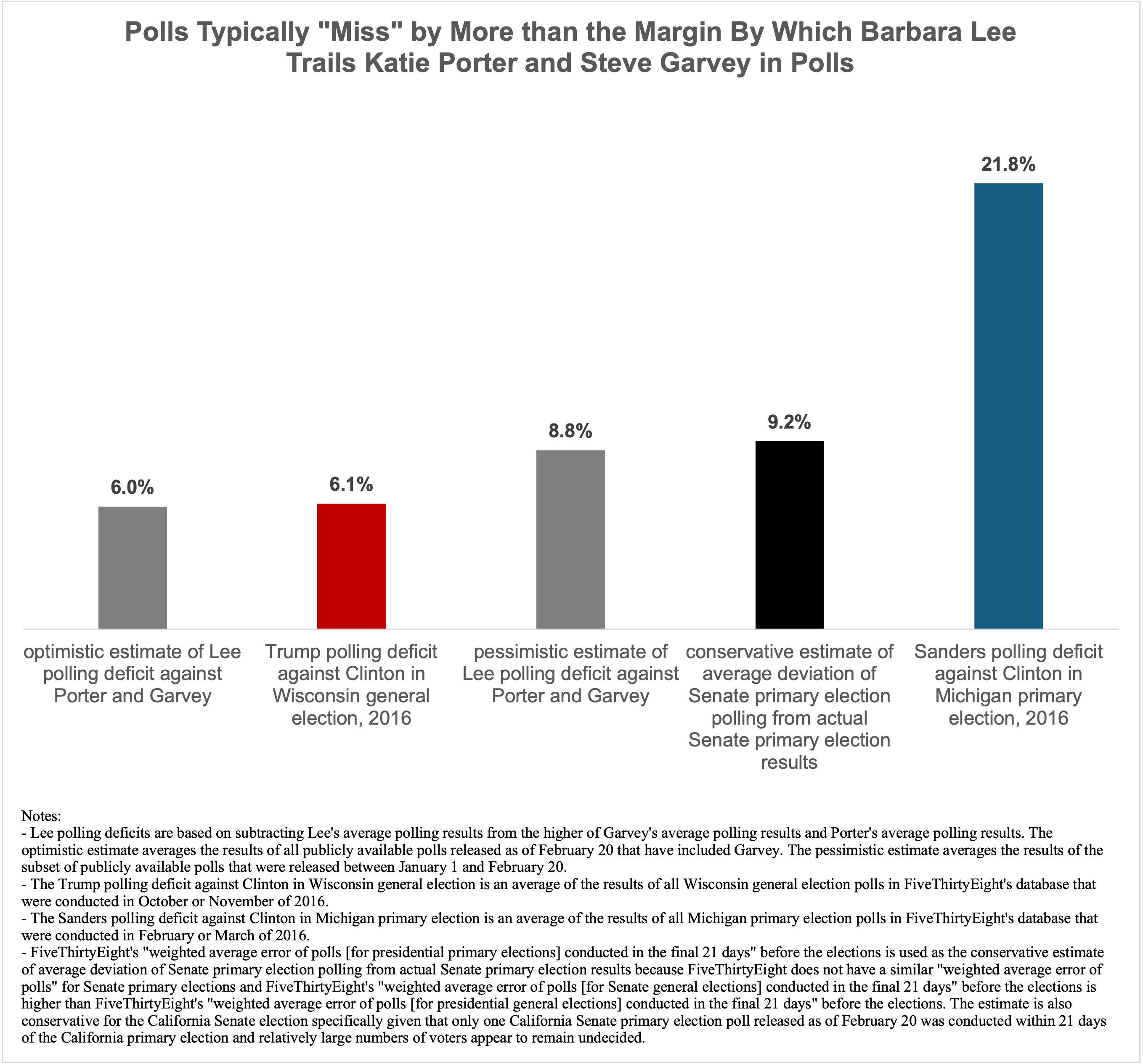
What do those polling numbers mean for Lee’s chances? During 2022 general elections for congressional and governors’ races, polls were historically accurate, but polling averages still tended to deviate from the actual results by 4.8 percentage points. In primaries, the expected deviation is much greater. Presidential general election poll margins have been about 4.3 percentage points off from the actual results on average, for instance, but presidential primary poll margins have deviated from primary results by more than twice as much: 9.2 percentage points. Senate election polls tend to be less accurate than presidential election polls, so 9.2 percentage points is a fairly conservative estimate of the potential difference we might expect to see between polling results and actual results in a Senate race with four major candidates and large numbers of voters still undecided. Even in the most pessimistic polling case one can make for Lee right now, therefore, Lee finishing in the top two is well within the range of the polls’ expected “absolute error,” as reputable poll analyzer FiveThirtyEight calls it. The chart below shows the pessimistic case in polling averages for Lee relative to what she’d need to beat both Porter and Garvey against this benchmark. It also shows average polling discrepancies between the two frontrunners from the month before the election in two other races Lee supporters may remember: the 2016 Democratic primary in Michigan and the 2016 general election in Wisconsin.
To be clear, I’d discourage Lee supporters from jumping ship even if the polls looked a lot worse. Predictions about who does and doesn’t have a chance to win elections are misguided in general for a variety of reasons: they rely on speculation about what large numbers of other people may or may not do, they can often be self-fulfilling prophecies, and they incentivize candidates to focus more on the horse race than on policy. Even when they’re grounded in careful data analysis – which they’re often not – they can still be spectacularly wrong, as Bernie Sanders’s primary win in Michigan 8 years ago shows. Candidates cannot win if the people who would otherwise support them vote for somebody else instead due to tactical considerations.
But if that doesn’t sway you, you should at least look carefully at the evidence. A top-two finish for Lee is well within the realm of possibility. Based on the historical data shown below (from FiveThirtyEight) for elections where the polling was almost certainly more accurate on average than polling for this year’s California Senate race, we can conservatively estimate that Lee’s chances of finishing in the top two are somewhere in between 14% and 31%.

Those aren’t chances for Lee’s supporters to be thrilled about. But they’re probably better than the 16.5% chance FiveThirtyEight gave Donald Trump to beat Hillary Clinton in Wisconsin in 2016. Conservatively, if we assume they’re 17%, they’re also higher than:
- the chance of rolling a die and getting any specific number you chose before you rolled (1/6, or approximately 16.7%);
- the chance of being dealt a 20 or 21 in a game of Blackjack being played with one deck (200/1326, or approximately 15.1%); and
- the chance a typical Major League Baseball hitter has of swinging and missing when Los Angeles Dodgers legend Clayton Kershaw throws a pitch (Kershaw’s highest single-season swinging strike percentage is 16.7%).
Importantly, Lee’s supporters can still raise her chances of a top-two finish. We can help Lee communicate with voters via advertisements by donating to her campaign. We can volunteer to send text messages, make phone calls, or knock on doors. We can personally reach out to family and friends who may either be undecided or thinking of supporting another candidate to explain why Lee’s long track record of pushing both for social and economic justice at home and for peace around the world – not to mention the fact that, if elected, she would be the only Black woman in the Senate – make her the Senator California needs.
Polling data suggests that, if every Lee supporter convinces just two new people to vote for Lee, she’d rival Schiff for frontrunner status. That’s a big if, of course. But so is the question of whether a vote for the second-best candidate would have its intended result. And unlike voting for someone else, persuading others to vote for Lee is a strategy social justice advocates can adopt to maximize our already-legitimate shot at the best possible outcome.

 34justice
Leave a comment